
Section 2.13 Week 13

Subsection Monday

Last week we developed the technology of barycentric subdivision and proved the small chains theorem: every homology class is represented by a chain whose simplices are entirely contained in members of any chosen open cover. Today we cash that in. We prove the excision theorem and the Mayer–Vietoris sequence, and then deploy them to compute our first family of nontrivial homology groups: \(H_*(S^n)\text{.}\) Two classical applications follow at once — the invariance of dimension and the Brouwer fixed point theorem.

Subsubsection Excision

Proof.
Let \(B:=X\setminus Z\text{.}\) The hypothesis \(\overline{Z}\subseteq\mathrm{int}\,A\) implies \(\mathrm{int}\,A\cup\mathrm{int}\,B = X\text{,}\) so \(\mathcal{U}:=\{A,B\}\) is a cover whose interiors cover \(X\text{.}\) Let \(C_\bullet^{\mathcal{U}}(X)\) be the subcomplex of \(\mathcal{U}\)-small chains and \(C_\bullet^{\mathcal{U}}(X,A):=C_\bullet^{\mathcal{U}}(X)/C_\bullet(A)\) the corresponding relative complex. By Theorem 2.12.13 and the five lemma applied to the long exact sequence of the pair, the inclusion \(C_\bullet^{\mathcal{U}}(X,A)\hookrightarrow C_\bullet(X,A)\) induces an isomorphism on homology.
On the other hand, every \(\mathcal{U}\)-small chain decomposes uniquely (modulo chains in \(A\)) as a sum of a chain in \(A\) and a chain in \(B\text{.}\) The inclusion \(C_\bullet(B)\hookrightarrow C_\bullet^{\mathcal{U}}(X)\) therefore descends to an isomorphism of relative complexes
\begin{equation*} C_\bullet(B)/C_\bullet(A\cap B)\;\xrightarrow{\;\sim\;}\;C_\bullet^{\mathcal{U}}(X)/C_\bullet(A). \end{equation*}
Since \(B=X\setminus Z\) and \(A\cap B=A\setminus Z\text{,}\) the left side is \(C_\bullet(X\setminus Z, A\setminus Z)\text{.}\) Composing the two isomorphisms yields the result.
Excision is the fundamental "locality" property of singular homology: removing a well-embedded subspace from both \(X\) and \(A\) does not change the relative homology. It is what distinguishes homology from, say, the homotopy groups \(\pi_n\text{,}\) which are not excisive.

Subsubsection The Mayer–Vietoris sequence

Let \(X=A\cup B\) with \(A,B\) subspaces whose interiors cover \(X\text{.}\) The small chains theorem provides a short exact sequence
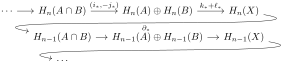
\begin{equation*} 0\to C_n(A\cap B)\xrightarrow{\;(i,-j)\;} C_n(A)\oplus C_n(B)\xrightarrow{\;k+\ell\;} C_n^{\mathcal{U}}(X)\to 0, \end{equation*}
where \(i\colon A\cap B\hookrightarrow A\text{,}\) \(j\colon A\cap B\hookrightarrow B\text{,}\) \(k\colon A\hookrightarrow X\text{,}\) and \(\ell\colon B\hookrightarrow X\) are the inclusions. (Exactness at the middle term is the "decomposition" used in the proof of excision; surjectivity at the right is the small chains theorem.) Passing to homology via the snake lemma yields:
Proof.
Apply the long exact sequence in homology to the short exact sequence of chain complexes displayed above, and use the small chains isomorphism \(H_n^{\mathcal{U}}(X)\cong H_n(X)\text{.}\)
There is also a reduced version: if \(A\cap B\) is nonempty, the same argument applied to the augmented complexes gives an exact sequence
\begin{equation*} \cdots\to\widetilde{H}_n(A\cap B)\to\widetilde{H}_n(A)\oplus\widetilde{H}_n(B)\to\widetilde{H}_n(X)\to\widetilde{H}_{n-1}(A\cap B)\to\cdots \end{equation*}
We will use the reduced form for spheres.
Schematically, the Mayer–Vietoris sequence reads:
The Mayer–Vietoris long exact sequence rendered as a zigzag, with rows for each degree connected by the connecting homomorphism.

Subsubsection Homology of spheres

Proof.
The case \(n=0\) is direct: \(S^0\) is two points, so \(H_0(S^0)\cong\mathbb{Z}^2\) and \(H_k(S^0)=0\) for \(k\ge 1\) by Proposition 2.11.11 and Proposition 2.11.20. We proceed by induction on \(n\ge 1\text{.}\)
Cover \(S^n\) by \(A:=S^n\setminus\{N\}\) and \(B:=S^n\setminus\{S\}\text{,}\) the complements of the north and south poles. Both \(A\) and \(B\) are open, and stereographic projection gives homeomorphisms \(A\cong\mathbb{R}^n\cong B\text{.}\) In particular \(A\) and \(B\) are contractible, so \(\widetilde{H}_*(A)=\widetilde{H}_*(B)=0\) by Corollary 2.11.21. The intersection \(A\cap B\) deformation retracts onto the equatorial \(S^{n-1}\text{;}\) concretely, the radial projection \((x,t)\mapsto x/|x|\) realizes \(A\cap B\simeq S^{n-1}\text{.}\)
The reduced Mayer–Vietoris sequence becomes
\begin{equation*} \cdots\to\widetilde{H}_k(A)\oplus\widetilde{H}_k(B)\to\widetilde{H}_k(S^n)\xrightarrow{\partial_*}\widetilde{H}_{k-1}(S^{n-1})\to\widetilde{H}_{k-1}(A)\oplus\widetilde{H}_{k-1}(B)\to\cdots \end{equation*}
which, since the \(A\)- and \(B\)-terms vanish, collapses to isomorphisms
\begin{equation*} \partial_*\colon\widetilde{H}_k(S^n)\xrightarrow{\;\sim\;}\widetilde{H}_{k-1}(S^{n-1})\quad\text{for all } k\ge 1. \end{equation*}
By induction \(\widetilde{H}_{k-1}(S^{n-1})\) is \(\mathbb{Z}\) when \(k-1=n-1\) and zero otherwise, giving the claim. The case \(k=0\) is handled by path-connectedness of \(S^n\) for \(n\ge 1\text{.}\)

Subsubsection Applications

Two classical consequences are immediate.
Proof.
Suppose \(m,n\ge 1\text{.}\) If \(S^m\simeq S^n\text{,}\) then \(\widetilde{H}_*(S^m)\cong\widetilde{H}_*(S^n)\) by Corollary 2.12.5; but Theorem 2.13.3 shows these are concentrated in different degrees. For \(\mathbb{R}^m\not\cong\mathbb{R}^n\text{,}\) observe that a hypothetical homeomorphism would restrict to a homeomorphism \(\mathbb{R}^m\setminus\{0\}\cong\mathbb{R}^n\setminus\{0'\}\) for some point \(0'\text{.}\) Since \(\mathbb{R}^k\setminus\{0\}\simeq S^{k-1}\text{,}\) this would give \(S^{m-1}\simeq S^{n-1}\text{,}\) contradicting the previous statement. The remaining cases (\(m=0\) or \(n=0\)) are handled by counting connected components.
Proof.
Such a retraction would give, with \(\iota\colon S^{n-1}\hookrightarrow D^n\text{,}\) \(r\circ\iota=\mathrm{id}_{S^{n-1}}\text{,}\) whence \(r_*\circ\iota_*=\mathrm{id}\) on \(\widetilde{H}_{n-1}\text{.}\) But \(\widetilde{H}_{n-1}(D^n)=0\) while \(\widetilde{H}_{n-1}(S^{n-1})\cong\mathbb{Z}\) — contradiction.
Proof.
Suppose \(f(x)\neq x\) for all \(x\in D^n\text{.}\) Define \(r\colon D^n\to S^{n-1}\) by sending \(x\) to the point where the ray from \(f(x)\) through \(x\) meets \(S^{n-1}\text{.}\) Then \(r\) is continuous and \(r|_{S^{n-1}}=\mathrm{id}\) (a point on the boundary maps to itself), giving a retraction \(D^n\to S^{n-1}\text{.}\) This contradicts Corollary 2.13.5.
On Wednesday we will leverage Mayer–Vietoris (and a related "good pair" version of excision) to compute the homology of further spaces — most notably the complex and real projective spaces. The key new input there is to understand the effect on homology of attaching a single cell, leading to the calculation
\begin{equation*} H_k(\mathbb{RP}^n) \cong \begin{cases} \mathbb{Z} \amp k=0,\\ \mathbb{Z}/2 \amp 0<k<n,\;k\text{ odd},\\ 0 \amp 0<k<n,\;k\text{ even},\\ \mathbb{Z} \amp k=n,\;n\text{ odd},\\ 0 \amp k=n,\;n\text{ even},\\ 0 \amp k>n. \end{cases} \end{equation*}

Subsection Wednesday

Today we put singular homology to work in earnest. We introduce one technical ingredient — the good-pair theorem, which identifies the relative homology \(H_*(X,A)\) with the reduced homology of the quotient \(X/A\) for nice pairs — and then carry out two cellular computations: \(H_*(\mathbb{CP}^n)\) (where the answer is uniformly \(\mathbb{Z}\) in every even degree up to \(2n\)) and \(H_*(\mathbb{RP}^n)\) (where torsion appears for the first time, courtesy of a degree-\(2\) attaching map).

Subsubsection The good-pair theorem

Let \((X,A)\) be a CW pair, meaning \(X\) is a CW complex and \(A\subseteq X\) is a subcomplex. The homotopy extension property of CW pairs (developed in week 10) implies that \(A\) has an open neighborhood \(V\subseteq X\) that deformation retracts onto \(A\) — concretely, an open thickening one cell at a time. We use this to relate \(H_n(X,A)\) to the homology of the quotient space.
Proof.
Choose an open neighborhood \(V\supseteq A\) in \(X\) that deformation retracts to \(A\text{.}\) The deformation retraction induces, by Theorem 2.12.6 and the five-lemma applied to the long exact sequence of the pair, an isomorphism \(H_n(X,A)\xrightarrow{\sim}H_n(X,V)\text{.}\) By excision (Theorem 2.13.1) applied to \(Z:=A\text{,}\) whose closure is contained in the interior of \(V\text{,}\)
\begin{equation*} H_n(X\setminus A,\, V\setminus A)\;\xrightarrow{\;\sim\;}\;H_n(X, V). \end{equation*}
The same argument applied inside \(X/A\) with \(A\) collapsed to the basepoint gives \(H_n(X/A,\, q(V)/A)\cong\widetilde{H}_n(X/A)\) together with an excision isomorphism \(H_n((X/A)\setminus(A/A),\,q(V)/A\setminus(A/A))\xrightarrow{\sim}H_n(X/A,\,q(V)/A)\text{.}\) But \(q\) restricts to a homeomorphism \(X\setminus A\xrightarrow{\sim}(X/A)\setminus(A/A)\) sending \(V\setminus A\) homeomorphically to \(q(V)/A\setminus(A/A)\text{,}\) so the two excised relative groups agree. Composing,
\begin{equation*} H_n(X,A) \;\cong\; H_n(X\setminus A, V\setminus A) \;\cong\; H_n(X/A, q(V)/A) \;\cong\; \widetilde{H}_n(X/A), \end{equation*}
and tracing through the construction shows the composite is \(q_*\text{.}\)
Combined with the long exact sequence of the pair \((X,A)\text{,}\) the good-pair theorem says that the homology of a CW complex is built up from the homology of its skeleta by a connecting map whose target we can identify with \(\widetilde{H}_*\) of an explicit quotient. In our applications, \(X/A\) will be a wedge of spheres — typically just a single sphere — and the sequence will be very tractable.

Subsubsection Complex projective space

Recall that \(\mathbb{CP}^n\) has a CW structure with exactly one cell in each even dimension \(0,2,4,\ldots,2n\) (and no cells in odd dimensions). The \(2k\)-skeleton is naturally \(\mathbb{CP}^k\text{,}\) and the \(2k\)-cell is attached to \(\mathbb{CP}^{k-1}\) via the Hopf map \(S^{2k-1}\to\mathbb{CP}^{k-1}\text{.}\)
Proof.
By induction on \(n\text{.}\) The base case \(n=0\) is \(\mathbb{CP}^0=\mathrm{pt}\text{,}\) for which the claim is Proposition 2.11.20. For the inductive step, consider the CW pair \((\mathbb{CP}^n,\mathbb{CP}^{n-1})\text{.}\) The quotient \(\mathbb{CP}^n/\mathbb{CP}^{n-1}\) is obtained by collapsing the boundary of the \(2n\)-cell to a point and so is homeomorphic to \(S^{2n}\text{.}\) The good-pair theorem (Theorem 2.13.7) and Theorem 2.13.3 yield
\begin{equation*} H_k(\mathbb{CP}^n,\mathbb{CP}^{n-1})\;\cong\;\widetilde{H}_k(S^{2n})\;=\; \begin{cases}\mathbb{Z}\amp k=2n,\\ 0\amp\text{otherwise}.\end{cases} \end{equation*}
The long exact sequence of the pair therefore reduces to
\begin{equation*} \cdots\to H_k(\mathbb{CP}^{n-1})\to H_k(\mathbb{CP}^n)\to H_k(\mathbb{CP}^n,\mathbb{CP}^{n-1})\to H_{k-1}(\mathbb{CP}^{n-1})\to\cdots \end{equation*}
with the relative term vanishing except in degree \(2n\text{.}\) Two cases:
Case \(k\neq 2n,2n-1\text{.}\) Both adjacent relative terms vanish, so \(H_k(\mathbb{CP}^n)\cong H_k(\mathbb{CP}^{n-1})\text{;}\) the inductive hypothesis gives the claimed value.
Cases \(k=2n\) or \(k=2n-1\text{.}\) The relevant portion of the long exact sequence is
\begin{equation*} 0 \to H_{2n}(\mathbb{CP}^{n-1})\to H_{2n}(\mathbb{CP}^n)\to\mathbb{Z}\xrightarrow{\partial}H_{2n-1}(\mathbb{CP}^{n-1})\to H_{2n-1}(\mathbb{CP}^n)\to 0. \end{equation*}
By induction, \(H_{2n}(\mathbb{CP}^{n-1})=0\) (because \(2n> 2(n-1)\)) and \(H_{2n-1}(\mathbb{CP}^{n-1})=0\) (because \(2n-1\) is odd). So the sequence collapses to
\begin{equation*} 0\to H_{2n}(\mathbb{CP}^n)\to\mathbb{Z}\to 0\to H_{2n-1}(\mathbb{CP}^n)\to 0, \end{equation*}
giving \(H_{2n}(\mathbb{CP}^n)\cong\mathbb{Z}\) and \(H_{2n-1}(\mathbb{CP}^n)=0\text{,}\) as claimed.
The computation is unusually painless because the absence of odd-dimensional cells makes the connecting map land in a zero group every time. The next example is harder because real projective space has cells in every dimension, so the connecting map carries genuine information.

Subsubsection Real projective space

Recall the CW structure on \(\mathbb{RP}^n\) with one \(k\)-cell in each dimension \(0\le k\le n\text{.}\) The \(k\)-skeleton is \(\mathbb{RP}^k\text{,}\) and the \(k\)-cell is attached to \(\mathbb{RP}^{k-1}\) via the antipodal quotient
\begin{equation*} \varphi_k\colon S^{k-1}\twoheadrightarrow S^{k-1}/(x\sim -x)\;=\;\mathbb{RP}^{k-1}. \end{equation*}
Collapsing \(\mathbb{RP}^{n-1}\) in \(\mathbb{RP}^n\) identifies the entire boundary of the top \(n\)-cell to a single point, so \(\mathbb{RP}^n/\mathbb{RP}^{n-1}\cong D^n/\partial D^n\cong S^n\text{.}\) By the good-pair theorem,
\begin{equation*} H_k(\mathbb{RP}^n,\mathbb{RP}^{n-1})\;\cong\;\widetilde{H}_k(S^n)\;=\;\begin{cases}\mathbb{Z}\amp k=n,\\ 0\amp\text{otherwise}.\end{cases} \end{equation*}
Plugging into the long exact sequence of the pair, every degree \(k\notin\{n,n-1\}\) gives an isomorphism \(H_k(\mathbb{RP}^{n-1})\cong H_k(\mathbb{RP}^n)\text{,}\) while the two interesting degrees fit into
\begin{equation*} 0\to H_n(\mathbb{RP}^{n-1})\to H_n(\mathbb{RP}^n)\to\mathbb{Z}\xrightarrow{\partial_n}H_{n-1}(\mathbb{RP}^{n-1})\to H_{n-1}(\mathbb{RP}^n)\to 0. \tag{\(*\)} \end{equation*}
Everything reduces to identifying the connecting map \(\partial_n\text{.}\)
Proof.
That \(\partial_n(1)=[\varphi_n]_*[S^{n-1}]\) is the standard description of the connecting homomorphism for a pair \((X,A)\) obtained by attaching an \(n\)-cell along \(\varphi\text{:}\) the boundary of the relative \(n\)-cycle (a singular simplex parameterizing the cell) is the image of the \((n-1)\)-sphere under the attaching map.
Case \(n\) odd. By induction (the case \(n-1\) of this very theorem, treating the base case \(n=1\) directly: \(\mathbb{RP}^1=S^1\)), \(H_{n-1}(\mathbb{RP}^{n-1})=0\) when \(n-1\) is even and \(n-1\ge 2\text{.}\) For \(n=1\) the connecting map lands in \(H_0(\mathbb{RP}^0)\cong\mathbb{Z}\) and is zero because \(\varphi_1\colon S^0\to\mathrm{pt}\) is constant. In all cases \(\partial_n=0\text{.}\)
Case \(n\) even. By induction, \(H_{n-1}(\mathbb{RP}^{n-1})\cong\mathbb{Z}\) (with \(n-1\) odd), and the quotient map \(q\colon\mathbb{RP}^{n-1}\to\mathbb{RP}^{n-1}/\mathbb{RP}^{n-2}\cong S^{n-1}\) induces an isomorphism on \(H_{n-1}\) — this is itself a special case of the same long exact sequence, applied one dimension down: in the analogue of (\(*\)) for \((\mathbb{RP}^{n-1},\mathbb{RP}^{n-2})\text{,}\) both \(H_{n-1}(\mathbb{RP}^{n-2})\) and \(H_{n-2}(\mathbb{RP}^{n-2})\to H_{n-2}(\mathbb{RP}^{n-1})\) are constrained so that \(q_*\colon H_{n-1}(\mathbb{RP}^{n-1})\to\widetilde{H}_{n-1}(S^{n-1})\cong\mathbb{Z}\) is an isomorphism (see the case \(n-1\) odd of the inductive hypothesis).
Pre-composing with \(q\) reduces the calculation to a self-map of \(S^{n-1}\text{:}\)
\begin{equation*} q\circ\varphi_n \colon S^{n-1}\to\mathbb{RP}^{n-1}\to S^{n-1}. \end{equation*}
This composite has degree \(1+(-1)^n=2\) (for \(n\) even) — geometrically, a generic point \(p\in S^{n-1}\) has two preimages in \(S^{n-1}\) under \(\varphi_n\) (namely \(p\) and its antipode), and the antipodal map on \(S^{n-1}\) has degree \((-1)^n=+1\text{,}\) so both preimages contribute with the same sign and the local degrees add. Therefore \((q\circ\varphi_n)_*=2\cdot\mathrm{id}_\mathbb{Z}\text{,}\) and applying \(q_*^{-1}\) shows \((\varphi_n)_*[S^{n-1}]=\pm 2\cdot\text{generator}\) of \(H_{n-1}(\mathbb{RP}^{n-1})\text{.}\)
Proof.
By induction on \(n\text{.}\) The base case \(n=1\) is \(\mathbb{RP}^1\cong S^1\text{,}\) with \(H_0=\mathbb{Z}\text{,}\) \(H_1=\mathbb{Z}\text{,}\) and higher groups zero — matching the formula (\(n=1\) is odd, so \(H_n=\mathbb{Z}\)).
Assume the formula for \(\mathbb{RP}^{n-1}\text{.}\) For \(k> n\text{,}\) both \(H_k(\mathbb{RP}^{n-1})\) and the relative term vanish, forcing \(H_k(\mathbb{RP}^n)=0\text{.}\) For \(0\le k\le n-2\text{,}\) the relative term is also zero on both sides, so \(H_k(\mathbb{RP}^n)\cong H_k(\mathbb{RP}^{n-1})\text{,}\) matching the formula. It remains to compute \(H_n(\mathbb{RP}^n)\) and \(H_{n-1}(\mathbb{RP}^n)\text{.}\) Recall the exact sequence (\(*\)) above:
\begin{equation*} 0\to H_n(\mathbb{RP}^{n-1})\to H_n(\mathbb{RP}^n)\to\mathbb{Z}\xrightarrow{\partial_n}H_{n-1}(\mathbb{RP}^{n-1})\to H_{n-1}(\mathbb{RP}^n)\to 0. \end{equation*}
By induction \(H_n(\mathbb{RP}^{n-1})=0\) (since \(n> n-1\)), so the sequence simplifies to
\begin{equation*} 0\to H_n(\mathbb{RP}^n)\to\mathbb{Z}\xrightarrow{\partial_n}H_{n-1}(\mathbb{RP}^{n-1})\to H_{n-1}(\mathbb{RP}^n)\to 0. \end{equation*}
We split on the parity of \(n\text{.}\)
Case \(n\) odd, \(n\ge 3\text{.}\) By induction \(H_{n-1}(\mathbb{RP}^{n-1})=0\) (since \(n-1\) is even and \(n-1=n-1\) is the top dimension of \(\mathbb{RP}^{n-1}\text{,}\) and the formula says this group vanishes). The exact sequence collapses to \(0\to H_n(\mathbb{RP}^n)\to\mathbb{Z}\to 0\to H_{n-1}(\mathbb{RP}^n)\to 0\text{,}\) yielding \(H_n(\mathbb{RP}^n)=\mathbb{Z}\) and \(H_{n-1}(\mathbb{RP}^n)=0\text{.}\) Both agree with the formula.
Case \(n\) even, \(n\ge 2\text{.}\) By induction \(H_{n-1}(\mathbb{RP}^{n-1})\cong\mathbb{Z}\) (since \(n-1\) is odd and \(n-1\) is the top dimension). By Lemma 2.13.9, the connecting map \(\partial_n\colon\mathbb{Z}\to\mathbb{Z}\) is multiplication by \(\pm 2\) — in particular, injective with image \(2\mathbb{Z}\text{.}\) Therefore \(H_n(\mathbb{RP}^n)=\ker\partial_n=0\) and \(H_{n-1}(\mathbb{RP}^n)=\mathbb{Z}/2\mathbb{Z}\text{.}\) Both match the formula.
The pattern of homology groups
\begin{equation*} \mathbb{Z},\;\mathbb{Z}/2,\;0,\;\mathbb{Z}/2,\;0,\;\mathbb{Z}/2,\;\ldots \end{equation*}
for \(\mathbb{RP}^\infty\) is striking: torsion appears in every odd positive degree and nothing else survives. It is a first-time encounter with non-free homology, and a first sign that \(\mathbb{Z}\)-coefficients are not always the cleanest place to work. Coefficients in \(\mathbb{Z}/2\text{,}\) where antipodal-degree subtleties disappear, give
\begin{equation*} H_k(\mathbb{RP}^n;\mathbb{Z}/2) \;\cong\; \mathbb{Z}/2 \quad\text{for all } 0\le k\le n, \end{equation*}
a phenomenon that motivates the systematic study of cohomology with arbitrary coefficients in a follow-up course.

Subsubsection Coda

We have come a long way: starting from open sets in January, working through the categorical apparatus of point-set topology, the homotopical language of CW complexes, the algebraic machinery of chain complexes, and finally arriving at excision and Mayer–Vietoris.
From here the natural continuations diverge. Cellular homology re-organizes today’s computation into a finite chain complex one can write down directly from the CW structure. Cohomology introduces a contravariant theory with a multiplicative structure (the cup product) that distinguishes spaces whose ordinary homology agrees. Universal coefficients, Künneth, and the Eilenberg–Steenrod axioms unify the picture. And the homotopy groups \(\pi_n(X)\text{,}\) which we have steered around all year because they fail excision, return as the deepest invariants of all. A second-semester sequel would visit each of these in turn.
For now: thank you, and well done.

