Section 2.3 Week 3

Subsection Monday

Subsubsection Real projective space

It is worthwhile for us to spend some more time contemplating real projective space. Our prior work tells us that \(\mathbb{RP}^n\) is built from two pieces: the upper hemisphere \(S^n_+\cong B^n\cong \mathbb R^n\) which is homeomorphic to an open \(n\)-ball and Euclidean \(n\)-space, and a copy of \(\mathbb{RP}^{n-1}\text{.}\) These pieces are glued together along the boundary of \(B^n\text{,}\) which is \(S^{n-1}\text{.}\)
As it turns out, it will be advantageous to package \(B^n\) and its boundary \(S^{n-1}\) into a single package, the closed \(n\)-disk
\begin{equation*} D^n := \{x\in \mathbb R^n\mid \lVert x\rVert\le 1\}. \end{equation*}
This space comes equipped with a continuous inclusion of its boundary \(S^{n-1}\hookrightarrow D^n\) which is compatible with the homeomorphism \(S^n_{\ge 0}\cong D^n\) given by projection onto the first \(n\) coordinates.
Each line through the origin in the \(x_n=0\) hyperplane passes through the \((n-1)\)-sphere \(S^{n-1}\) twice at antipodal points. It follows that
\begin{equation*} \mathbb{RP}^{n-1}\cong S^{n-1}/(x\sim -x), \end{equation*}
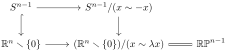
which the reader may prove by contemplating
described in detail following the image
A commutative diagram relating \(S^{n-1}\text{,}\) its antipodal quotient, the punctured space \(\mathbb{R}^n\setminus\{0\}\text{,}\) the radial-scaling quotient, and \(\mathbb{RP}^{n-1}\text{.}\)
From this, we see that the restriction of the quotient map \(\mathbb R^{n+1}\smallsetminus \{0\} \to \mathbb{RP}^n\) to the copy of \(S^{n-1}\) in the \(x_n=0\) hyperplane is a continuous quotient map onto \(\mathbb{RP}^{n-1}\text{.}\) It follows that we have the commutative diagram
described in detail following the image
A commutative square expressing how \(\mathbb{RP}^n\) is the union of \(D^n\) and \(\mathbb{RP}^{n-1}\) along \(S^{n-1}\text{.}\)
It turns out that \(\mathbb{RP}^n\) is the "initial" space with which we can fill in the bottom right corner of the diagram. This means that \(\mathbb{RP}^n\) is the pushout of \(D^n\) and \(\mathbb{RP}^{n-1}\) along \(S^{n-1}\text{,}\) a concept we will make precise momentarily.
Remark 2.3.1. Coordinates for real projective space.
We can write \([x_0:x_1:\cdots:x_n]\) for the equivalence class of \((x_0,x_1,\ldots,x_n)\in \mathbb R^{n+1}\smallsetminus \{0\}\) in
\begin{equation*} \mathbb{RP}^n = (\mathbb{R}^{n+1}\smallsetminus \{0\})/\mathbb R^\times. \end{equation*}
As such, \([x_0:\cdots:x_n] = [\lambda x_0:\cdots:\lambda x_n]\) for all \(\lambda\in \mathbb R^\times\text{.}\)
In particular, if \(x_n\ne 0\text{,}\) then
\begin{equation*} [x_0:x_1:\cdots:x_{n-1}:x_n] = [x_0/x_n:x_1/x_n:\cdots:x_{n-1}/x_n:1]. \end{equation*}
Points like this form the copy of \(\mathbb R^n\cong B^n\subseteq D^n\) in the above depiction of \(\mathbb{RP}^n\text{.}\)
Meanwhile, the complement of this locus consists of points of the form \([x_0:\cdots:x_{n-1}:0]\) with \((x_0,\ldots,x_n)\ne 0\text{.}\) These form a copy of \(\mathbb{RP}^{n-1}\text{,}\) precisely the one that appears in the top right corner of the diagram above.

Subsubsection Pushouts

We now work in an arbitrary category \(\mathsf C\text{.}\) A span in \(\mathsf C\) is a diagram of the form \(X\leftarrow Z\to Y\) where \(X,Y,Z\) are objects of \(\mathsf C\) and both arrows are morphisms of \(\mathsf C\text{.}\)
Remark 2.3.2. Span and cospan diagrams in categories.
There is a category \(\mathsf S\) with only three objects β€” call them \(0,1,2\) β€” and with exactly two non-identity morphisms, \(1\leftarrow 0\to 2\text{.}\) (Make sure you understand how composition works in this category β€” there’s not much to define or check!) A span in a category \(\mathsf C\) is the same thing as a functor \(\mathsf S\to \mathsf C\text{.}\) A cospan in \(\mathsf C\) is a functor \(\mathsf S^{\text{op}}\to \mathsf C\text{,}\) that is, a diagram in \(\mathsf C\) of shape \(X\to Z\leftarrow Y\text{.}\)
Definition 2.3.3. Pushouts.
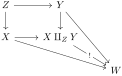
The pushout of a span in a category \(\mathsf C\) β€” when it exists β€” is an object \(X\amalg_Y Z\) of \(\mathsf C\) equipped with morphisms \(X\xrightarrow{i_X} X\amalg_Y Z\xleftarrow{i_Y} Y\) such that the diagram
described in detail following the image
A commutative square with span \(X\leftarrow Z\to Y\) in the top left and cospan \(X\xrightarrow{i_X} X\amalg_Y Z\xleftarrow{i_Y} Y\) in the bottom right.
commutes in \(\mathsf C\) and if
described in detail following the image
A commutative square with span \(X\leftarrow Z\to Y\) in the top left and cospan \(X\to W\leftarrow Y\) in the bottom right.
is another commutative diagram in \(\mathsf C\) completing the original span to a square, then there is a unique morphism \(!\colon X\amalg_Y Z\to W\) making the diagram
described in detail following the image
A commutative square with span \(X\leftarrow Z\to Y\) in the top left and cospan \(X\to W\leftarrow Y\) in the bottom right.
commute.
Checkpoint 2.3.4. Pushouts are unique up to unique isomorphism.
Prove that \(X\amalg_YZ\) is unique up to unique isomorphism. This means that if \(P\text{,}\) equipped with morphisms \(X\to P\leftarrow Y\text{,}\) is another object of \(\mathsf C\) satisfying the pushout universal property, then there is a unique isomorphism \(!\colon X\amalg_YZ\xrightarrow{\cong}P\) such that
described in detail following the image
A commutative square with span \(X\leftarrow Z\to Y\) in the top left and cospan \(X\to W\leftarrow Y\) in the bottom right.
commutes.
The reader may check that for sets \(A,B\subseteq X\text{,}\) the pushout of the natural span \(A\hookleftarrow A\cap B\hookrightarrow B\) is \(A\cup B\text{.}\) This is one sense in which we think of pushouts as gluing the ends of a span together along the middle term, refined by the following proposition.
We can also see that the pushout of \(A\leftarrow\varnothing\to B\) is \(A\amalg B\text{,}\) the disjoint union of \(A\) and \(B\text{.}\) Recall that \(A\amalg B := A\times \{0\}\cup B\times \{1\}\text{,}\) where the labels \(0,1\) serve to separate \(A\) and \(B\text{,}\) ensuring there is no overlap among the two sets.
Proof.
Given another cospan \(X\xrightarrow{s} W\xleftarrow{t} Y\) completing the span \(X\xleftarrow{f} Z\xrightarrow{g} Y\) to a commutative square, we define
\begin{align*} !\colon X\amalg_ZY \amp \longrightarrow W\\ [a] \amp \longmapsto \begin{cases} s(a) \amp \text{if }a\in X,\\ t(a) \amp \text{if }a\in Y. \end{align*}
The reader may check that \(!\) is well-defined (because the square involving \(W\) commutes), that \(!\circ i_X = s\) and \(!\circ i_Y = t\text{,}\) and that no other such function exists.

Subsection Wednesday

Subsubsection Pushouts in Top

We are now prepared to study pushouts in \(\mathsf{Top}\text{.}\)
Definition 2.3.6.
Given spaces \(X,Y,Z\) and continuous functions \(X\xleftarrow{f}Z\xrightarrow{g}Y\text{,}\) the pushout of \(X\) and \(Y\) along \(Z\) (via \(f\) and \(g\)) is the pushout of the span \(X\xleftarrow{f}Z\xrightarrow{g}Y\) in \(\mathsf{Top}\text{.}\)
Hmmm. That’s not very satisfying, is it? And yet, via the universal property expressed in DefinitionΒ 2.3.3, it’s exactly how we will construct continuous maps out of pushouts! And since pushouts are unique up to unique isomorphism, this definition guarantees that at most one pushout (up to unique homeomorphism compatible with the diagram) exists.
In order to get a better feel for pushouts in \(\mathsf{Top}\) and guarantee their existence, we must provide an explicit construction.
Proof.
The form of the underlying set is already guaranteed by PropositionΒ 2.3.5, and the reader may check that the open sets above indeed form a topology. Let \(Q\) denote the associated space. Observe that \(i_X\colon X\to Q\) and \(i_Y\colon Y\to Q\) are guaranteed to be continuous.
Let \(W\) be a topological space and suppose we are given continuous maps \(u:X\to W\) and \(v:Y\to W\) such that \(u\circ f=v\circ g\text{.}\) Since \(Q\) is the pushout of the underlying sets, there exists a unique function \(h:Q\to W\) with \(h\circ i_X=u\) and \(h\circ i_Y=v\text{.}\) It remains to show that \(h\) is continuous.
Let \(V\subseteq W\) be open. Then
\begin{equation*} i_X^{-1}\bigl(h^{-1}V\bigr) = (h\circ i_X)^{-1}(V) = u^{-1}(V) \end{equation*}
and
\begin{equation*} i_Y^{-1}\bigl(h^{-1}V\bigr) = (h\circ i_Y)^{-1}V = v^{-1}V. \end{equation*}
Since \(u\) and \(v\) are continuous, both \(u^{-1}V\) and \(v^{-1}V\) are open in \(X\) and \(Y\text{,}\) respectively. Therefore \(h^{-1}V\) is open in \(Q\) by definition of the topology, which proves that \(h\) is continuous. Uniqueness of \(h\) as a continuous map follows from uniqueness of the underlying function in PropositionΒ 2.3.5.
Thus \(Q\) together with \(i_X\) and \(i_Y\) satisfies the pushout universal property in \(\mathsf{Top}\text{,}\) so pushouts exist and are given by the stated construction.
Definition 2.3.8. Coproducts.
The coproduct of spaces \(X\) and \(Y\text{,}\) denoted \(X\amalg Y\text{,}\) is the pushout of the unique span of the form \(X\leftarrow \varnothing\to Y\text{.}\) In particular, \(X\amalg Y\) has underlying set the disjoint union of \(X\) and \(Y\) and its open subsets \(U\subseteq X\amalg Y\) are precisely those for which \(U\cap X\) and \(U\cap Y\) are open.
Example 2.3.9. The circle as a pushout.
Recall that \(S^0 = \{\pm 1\}\subseteq \mathbb R\) is the 0-sphere, which includes into \(D^1 = [-1,1]\) as its boundary. The circle \(S^1\) is the pushout of \(D^1\leftarrow S^0\to D^1\text{.}\) Indeed, \(D^1\amalg_{S^0}D^1\) consists of two disjoint intervals β€” the north semicircle and south semicircle β€” glued together left endpoint to left endpoint and right endpoint to right endpoint. (It follows from definitions that the pushout admits a continuous bijection to \(S^1\text{.}\) Later, we will have a general theorem guaranteeing a continuous bijection from a compact space to a Hausdorff space is a homeomorphism. We will write "by \(C\to H\)" to designate this caveat.)
Example 2.3.10. Spheres as pushouts.
Simiarly, the \(n\)-sphere is the pushout of \(D^n\leftarrow S^{n-1}\to D^n\) (by \(C\to H\)). One copy of \(D^n\) forms the upper hemisphere, and the other is the southern hemisphere, glued together along the equator \(S^{n-1}\text{.}\)
Example 2.3.11. Two pushout presentations of projective space.
We have already discussed how to present \(\mathbb{RP}^n\) as the pushout of \(D^n\leftarrow S^{n-1}\to \mathbb{RP}^{n-1}\text{.}\) But we can also describe \(\mathbb{RP}^n\) as the union of
\begin{equation*} U_0 = \{[x_0:x_1:\cdots:x_n]\mid x_0\ne 0\} \end{equation*}
and
\begin{equation*} U_1 = \{[x_0:x_1:\cdots:x_n] \mid x_1\ne 0\}. \end{equation*}
There are homeomorphisms \(\varphi_i\colon U_i\xrightarrow{\cong}\mathbb R^n\) given by taking \([x_0:x_1:\cdots:x_n]\) to either \((x_1/x_0,\ldots,x_n/x_0)\) (when \(i=0\)) or \((x_0/x_1,x_2/x_1,\ldots,x_n/x_1)\) (wnen \(i=1\)). The intersection \(U_0\cap U_1\) is homeomorphic (via \(\varphi_0\)) to \((\mathbb R\smallsetminus \{0\})\times \mathbb R^{n-1}\text{.}\) It follows (by \(C\to H\)) that \(\mathbb{RP}^n\) is also the pushout of a span of the form \(\mathbb R^n\leftarrow (\mathbb R\smallsetminus \{0\})\times \mathbb R^{n-1}\to \mathbb R^n\) where the first map is the standard inclusion, and the latter is given by
\begin{equation*} (u_1,u_2,\ldots,u_n)\longmapsto (1/u_1,u_2/u_1,\ldots,u_n/u_1). \end{equation*}

Subsubsection Categorical products and the product topology

Throughout, let \(\mathsf C\) denote a fixed but arbitrary category.
Definition 2.3.12. Categorical products.
Given objects \(x,y\) of \(\mathsf C\text{,}\) the product of \(x,y\) (when it exists) is an object \(x\times y\) equipped with morphisms
\begin{equation*} x\xleftarrow{\operatorname{pr}_x} x\times y \xrightarrow{\operatorname{pr}_y} y \end{equation*}
called projections and such that if \(x\xleftarrow{f} z\xrightarrow{g} y\) is another pair of morphisms to \(x,y\text{,}\) then there is a unique morphisms \((f,g)\colon z\to x\) such that
\begin{equation*} \operatorname{pr}_x\circ (f,g) = f\qquad\text{and}\qquad \operatorname{pr}_y\circ (f,g)=g. \end{equation*}
Checkpoint 2.3.13.
Check that products in \(\mathsf C\) are unique up to unique isomorphism when they exist. In other words, if
\begin{equation*} x\xleftarrow{p_x} p\xrightarrow{p_y} y\qquad\text{and}\qquad x\xleftarrow{q_x} q\xrightarrow{q_y} y \end{equation*}
are both products of \(x,y\text{,}\) then there is a unique isomorphism \(f\colon p\xrightarrow{\cong}q\) such that
\begin{equation*} p_x = q_x\circ f\qquad\text{and}\qquad p_y = q_y\circ f. \end{equation*}
You are already familiar with the product in \(\mathsf{Set}\text{:}\) it is exactly the Cartesian product equipped with its usual projection maps. The universal property of DefinitionΒ 2.3.12 says precisely that a function \(C\to A\times B\) is determined by its component functions.
Given DefinitionΒ 2.3.12, we already have a definition of the product of two topological spaces; it’s just the product in \(\mathsf{Top}\text{.}\) Our next task is to construct the product, thus proving that \(\mathsf{Top}\) has (binary) products.
Before proving the proposition, we state a useful lemma which the reader can prove.
Proof of PropositionΒ 2.3.14.
The reader may check that we have specified a topology on \(X\times Y\text{.}\) Given another space \(Z\) and continuous functions \(X\xleftarrow{f}Z\xrightarrow{g}Y\text{,}\) we already know (by the universal property of products in \(\mathsf{Set}\)) that there is a unique function \((f,g)\colon Z\to X\times Y\) such that composing with projection onto either factor results in \(f\text{,}\) \(g\text{,}\) respectively.
It remains to show that \((f,g)\) is continuous. By LemmaΒ 2.3.15, it suffices to check that \((f,g)^{-1}[U\times V]\subseteq Z\) is open for \(U\times V\in\mathscr B\text{.}\) We have
\begin{equation*} (f,g)^{-1}[U\times V] = \{(x,y)\in X\times Y\mid (f(x),g(y))\in U\times V\} = f^{-1}U\cap g^{-1}V. \end{equation*}
Since \(f\) and \(g\) are continuous (and finite intersections of open sets are open), this set is open in \(Z\text{,}\) concluding our proof.

Subsection Friday

We spent this class period finishing up the material from Wednesday and working in small groups on homework.