Section 2.10 Week 10

Subsection Monday

We now transition from point-set topology to algebraic topology. The central idea is to study topological spaces not just up to homeomorphism, but up to a coarser equivalence relation β€” homotopy equivalence β€” that retains enough geometric information for many applications while being far more flexible. The compact-open topology from last week provides a conceptual bridge: since the compact-open topology is always splitting, a homotopy (a continuous map \(X\times[0,1]\to Y\)) curries to a path in the mapping space \(Y^X\text{.}\) When \(X\) is locally compact, the exponential adjunction \(X\times(-)\dashv(-)^X\) makes this a perfect correspondence.

Subsubsection Homotopy of maps

Definition 2.10.1. Homotopy.
Let \(X\) and \(Y\) be topological spaces and let \(f_0,f_1\colon X\to Y\) be continuous maps. A homotopy from \(f_0\) to \(f_1\) is a continuous map
\begin{equation*} h\colon X\times[0,1]\longrightarrow Y \end{equation*}
such that \(h(x,0)=f_0(x)\) and \(h(x,1)=f_1(x)\) for all \(x\in X\text{.}\) When such a homotopy exists, we say \(f_0\) and \(f_1\) are homotopic and write \(f_0\simeq f_1\text{.}\)
A homotopy is a continuous one-parameter family of maps: at time \(t=0\) we have \(f_0\text{,}\) at time \(t=1\) we have \(f_1\text{,}\) and the map varies continuously in between. Using the compact-open topology, we can connect homotopies to paths in the mapping space \(Y^X\text{.}\) Since the compact-open topology is always splitting, a homotopy \(h\colon X\times[0,1]\to Y\) curries to a continuous path \(\hat{h}\colon[0,1]\to Y^X\) with \(\hat{h}(0)=f_0\) and \(\hat{h}(1)=f_1\text{.}\) Conversely, if \(X\) is locally compact, then the compact-open topology is also conjoining, and every path in \(Y^X\) uncurries to a homotopy. For general \(X\text{,}\) however, the converse may fail: there can be paths in \(Y^X\) that do not correspond to homotopies.
Remark 2.10.2.
It is sometimes important to require a homotopy to fix a subspace. If \(A\subseteq X\) and \(f_0|_A = f_1|_A\text{,}\) a homotopy relative to \(A\) (or homotopy rel \(A\)) is a homotopy \(h\) such that \(h(a,t)=f_0(a)\) for all \(a\in A\) and all \(t\in[0,1]\text{.}\) We write \(f_0\simeq f_1\;\mathrm{rel}\;A\text{.}\)
Proof.
Reflexivity. The constant homotopy \(h(x,t)=f(x)\) shows \(f\simeq f\text{.}\)
Symmetry. If \(h\) is a homotopy from \(f_0\) to \(f_1\text{,}\) then \(\bar{h}(x,t):=h(x,1-t)\) is a homotopy from \(f_1\) to \(f_0\text{.}\)
Transitivity. If \(h\) is a homotopy from \(f_0\) to \(f_1\) and \(h'\) is a homotopy from \(f_1\) to \(f_2\text{,}\) then
\begin{equation*} h''(x,t) := \begin{cases} h(x,2t) \amp \text{if } 0\le t\le\tfrac{1}{2},\\ h'(x,2t-1) \amp \text{if } \tfrac{1}{2}\le t\le 1, \end{cases} \end{equation*}
is a homotopy from \(f_0\) to \(f_2\text{.}\) This is continuous by the gluing lemma (the two definitions agree at \(t=\tfrac{1}{2}\) since \(h(x,1)=f_1(x)=h'(x,0)\)).
The set of homotopy classes \([X,Y]:=\mathsf{Top}(X,Y)/{\simeq}\) is one of the fundamental objects of algebraic topology. Homotopy is also compatible with composition.
Proof.
Let \(h\) be a homotopy from \(f_0\) to \(f_1\text{.}\) Then \(g_0\circ h\) is a homotopy from \(g_0\circ f_0\) to \(g_0\circ f_1\text{.}\) Now let \(h'\) be a homotopy from \(g_0\) to \(g_1\text{.}\) The map \((x,t)\mapsto h'(f_1(x),t)\) is a homotopy from \(g_0\circ f_1\) to \(g_1\circ f_1\text{.}\) Composing these two homotopies by transitivity gives \(g_0\circ f_0\simeq g_1\circ f_1\text{.}\)
Remark 2.10.5.
These two lemmas together say that there is a well-defined homotopy category \(\mathsf{hTop}\) whose objects are topological spaces and whose morphisms are homotopy classes of continuous maps. This is the natural home for algebraic topology.
Example 2.10.6. First examples of homotopies.
  1. Straight-line homotopy. Let \(f_0,f_1\colon X\to\mathbb{R}^n\) be continuous. Then \(h(x,t):=(1-t)f_0(x)+tf_1(x)\) is a homotopy from \(f_0\) to \(f_1\text{.}\) In particular, any two maps into \(\mathbb{R}^n\) are homotopic.
  2. Nullhomotopic maps. A continuous map \(f\colon X\to Y\) is nullhomotopic if it is homotopic to a constant map. Every map into \(\mathbb{R}^n\) is nullhomotopic.
  3. Maps out of \(\mathbb{R}^n\text{.}\) The identity map \(\mathrm{id}_{\mathbb{R}^n}\) is homotopic to the constant map at the origin via \(h(x,t)=(1-t)x\text{.}\) This is a homotopy that "contracts" all of \(\mathbb{R}^n\) to the origin.

Subsubsection Homotopy equivalence

Definition 2.10.7. Homotopy equivalence.
A continuous map \(f\colon X\to Y\) is a homotopy equivalence if there exists a continuous map \(g\colon Y\to X\) such that \(g\circ f\simeq\mathrm{id}_X\) and \(f\circ g\simeq\mathrm{id}_Y\text{.}\) In this case we say \(X\) and \(Y\) are homotopy equivalent (or have the same homotopy type) and write \(X\simeq Y\text{.}\) The map \(g\) is a homotopy inverse of \(f\text{.}\)
Every homeomorphism is a homotopy equivalence, but the converse is far from true. Homotopy equivalence is a much coarser relation: it identifies spaces that have the "same shape" in a flexible sense, even if they are not topologically identical.
Definition 2.10.8. Contractible space.
A space \(X\) is contractible if it is homotopy equivalent to a point, i.e., if the identity map \(\mathrm{id}_X\) is nullhomotopic. Equivalently, \(X\) is contractible if there exists a point \(x_0\in X\) and a continuous map \(h\colon X\times[0,1]\to X\) with \(h(x,0)=x\) and \(h(x,1)=x_0\) for all \(x\in X\text{.}\)
Example 2.10.9. Contractible spaces.
  1. \(\mathbb{R}^n\) is contractible: the map \(h(x,t)=(1-t)x\) contracts it to the origin.
  2. More generally, any convex subset \(C\subseteq\mathbb{R}^n\) is contractible. In particular, every disk \(D^n\) is contractible.
  3. Any star-shaped subset of \(\mathbb{R}^n\) is contractible.
Example 2.10.10. Non-contractible spaces.
The spheres \(S^n\) for \(n\ge 0\) are not contractible (and in particular not homotopy equivalent to a point). The proof that \(S^1\) is not contractible requires the fundamental group or homology; we will be able to prove this in two weeks. That \(S^0=\{-1,+1\}\) is not contractible is immediate: it is disconnected, and contractible spaces are path-connected (hence connected).

Subsubsection Deformation retracts

The most common way to prove two spaces are homotopy equivalent is to show that one deformation retracts onto the other.
Definition 2.10.11. Retract and retraction.
Let \(A\subseteq X\) be a subspace. A retraction of \(X\) onto \(A\) is a continuous map \(r\colon X\to A\) such that \(r(a)=a\) for all \(a\in A\text{,}\) i.e., \(r\circ\iota=\mathrm{id}_A\) where \(\iota\colon A\hookrightarrow X\) is the inclusion. If such a map exists, we call \(A\) a retract of \(X\text{.}\)
Definition 2.10.12. Deformation retract.
A subspace \(A\subseteq X\) is a deformation retract of \(X\) if there exists a continuous map \(h\colon X\times[0,1]\to X\) such that
  1. \(h(x,0)=x\) for all \(x\in X\text{,}\)
  2. \(h(x,1)\in A\) for all \(x\in X\text{,}\)
  3. \(h(a,t)=a\) for all \(a\in A\) and all \(t\in[0,1]\text{.}\)
Such a map \(h\) is a deformation retraction. If only conditions (1) and (2) hold β€” so that \(r:=h(-,1)\colon X\to A\) is a retraction and \(\iota\circ r\simeq\mathrm{id}_X\text{,}\) but the homotopy is not required to fix \(A\) pointwise β€” we call \(A\) a weak deformation retract.
Proof.
We have \(r\circ\iota=\mathrm{id}_A\) (since \(r\) is a retraction) and \(\iota\circ r\simeq\mathrm{id}_X\) (via the deformation retraction \(h\)).
Example 2.10.14. Deformation retracts.
  1. Punctured Euclidean space. \(\mathbb{R}^n\smallsetminus\{0\}\) deformation retracts onto \(S^{n-1}\) via \(h(x,t)=(1-t)x+t\frac{x}{|x|}\text{.}\) At \(t=0\) this is the identity, and at \(t=1\) this is the radial projection \(x\mapsto x/|x|\text{.}\) Points already on \(S^{n-1}\) are fixed throughout. Thus \(\mathbb{R}^n\smallsetminus\{0\}\simeq S^{n-1}\text{.}\)
  2. MΓΆbius band. The MΓΆbius band deformation retracts onto its central circle (an embedded copy of \(S^1\)), so the MΓΆbius band is homotopy equivalent to \(S^1\text{.}\)
  3. Figure-eight neighborhood. The open set \(\mathbb{R}^2\smallsetminus\{p,q\}\) (the plane with two points removed) deformation retracts onto a figure-eight β€” the wedge \(S^1\vee S^1\text{.}\)
  4. Cylinder. The cylinder \(X\times[0,1]\) deformation retracts onto \(X\times\{0\}\cong X\) via \(h((x,s),t)=(x,(1-t)s)\text{.}\) More generally, for any subspace \(A\subseteq X\text{,}\) the product \(A\times[0,1]\) deformation retracts onto \(A\times\{0\}\text{.}\)
Deformation retracts give us a useful way to think about homotopy equivalence geometrically: two spaces are homotopy equivalent when one can be continuously deformed into the other. The following proposition makes this precise.
Proof.
The "if" direction is clear: if \(X\) and \(Y\) are both deformation retracts of \(Z\text{,}\) then \(X\simeq Z\simeq Y\) by LemmaΒ 2.10.13.
For the "only if" direction, suppose \(f\colon X\to Y\) is a homotopy equivalence. One can show that \(X\) is a deformation retract of the mapping cylinder \(M_f := (X\times[0,1])\amalg_f Y\text{,}\) which is the pushout
\begin{equation*} M_f := (X\times[0,1])\amalg Y\big/\!\sim, \qquad (x,0)\sim f(x), \end{equation*}
and \(Y\) includes into \(M_f\) as the subspace \(Y\hookrightarrow M_f\) at the base. When \(f\) is a homotopy equivalence, both \(X\cong X\times\{1\}\) and \(Y\) are deformation retracts of \(M_f\text{.}\)

Subsubsection Homotopy invariants

A homotopy invariant is a quantity or structure assigned to topological spaces that is preserved by homotopy equivalences. We have already seen one.
Proof.
Let \(h\colon X\times[0,1]\to Y\) be a homotopy from \(f\) to \(g\text{.}\) For any \(x\in X\text{,}\) the map \(t\mapsto h(x,t)\) is a path from \(f(x)\) to \(g(x)\) in \(Y\text{.}\) Thus \(f(x)\) and \(g(x)\) lie in the same path-component, so \(\pi_0(f)([x])=\pi_0(g)([x])\text{.}\)
Our goal over the remaining four weeks is to construct much richer homotopy invariants β€” the homology groups \(H_n(X)\) β€” that can distinguish spaces \(\pi_0\) cannot. For instance, \(S^1\) and \(D^2\) are both path-connected (so \(\pi_0\) sees no difference), but we will show \(H_1(S^1)\cong\mathbb{Z}\) while \(H_1(D^2)=0\text{,}\) proving they are not homotopy equivalent.

Subsection Wednesday

Having established the language of homotopy, we now introduce one of the most important classes of topological spaces in algebraic topology: CW complexes. These are spaces built by iteratively attaching cells β€” a construction we already encountered when building spheres and projective spaces via pushouts in Week 3. CW complexes provide a class of spaces large enough to include all manifolds and most spaces arising in practice, yet structured enough that algebraic invariants (like homology) can be computed effectively.

Subsubsection Cell attachment via pushouts

Recall from SectionΒ 2.3 that a pushout in \(\mathsf{Top}\) glues two spaces together along a common subspace. The fundamental building block of a CW complex is the operation of attaching an \(n\)-cell: given a space \(X\) and a continuous map \(\varphi\colon S^{n-1}\to X\) (the attaching map), the space obtained by attaching an \(n\)-cell along \(\varphi\) is the pushout
\begin{equation*} X\amalg_\varphi D^n \;:=\; X\amalg D^n\big/\!\sim, \qquad z\sim\varphi(z) \text{ for } z\in S^{n-1}=\partial D^n. \end{equation*}
In the language of pushouts, this is the pushout of the span \(X\xleftarrow{\varphi}S^{n-1}\xrightarrow{\iota}D^n\text{,}\) where \(\iota\) is the inclusion of the boundary sphere into the disk. The image of the interior of \(D^n\) in the pushout is an open \(n\)-cell, homeomorphic to \(\mathbb{R}^n\text{.}\)
More generally, we can attach several \(n\)-cells simultaneously. Given a family of attaching maps \(\{\varphi_\alpha\colon S^{n-1}\to X\}_{\alpha\in A}\text{,}\) we form the pushout
\begin{equation*} X\amalg_{\{\varphi_\alpha\}}\!\left(\coprod_{\alpha\in A}D^n_\alpha\right) \;:=\; X\amalg\coprod_\alpha D^n_\alpha\Big/\!\sim, \qquad z\sim\varphi_\alpha(z) \text{ for } z\in\partial D^n_\alpha. \end{equation*}
Example 2.10.17. Spheres via cell attachment.
The sphere \(S^n\) is obtained from a point \(e^0\) by attaching a single \(n\)-cell via the unique (constant) map \(\varphi\colon S^{n-1}\to e^0\text{.}\) The resulting pushout is
\begin{equation*} S^n \;\cong\; e^0\amalg_\varphi D^n \;=\; D^n\big/\partial D^n, \end{equation*}
the disk with its boundary collapsed to a point. This gives \(S^n\) a CW structure with exactly two cells: one \(0\)-cell and one \(n\)-cell.

Subsubsection CW complexes

Definition 2.10.18. CW complex.
A CW complex is a topological space \(X\) equipped with a filtration
\begin{equation*} X^0\subseteq X^1\subseteq X^2\subseteq\cdots\subseteq X = \bigcup_{n\ge 0}X^n \end{equation*}
constructed inductively as follows.
  1. The \(0\)-skeleton \(X^0\) is a discrete set of points (the \(0\)-cells).
  2. For each \(n\ge 1\text{,}\) the \(n\)-skeleton \(X^n\) is obtained from \(X^{n-1}\) by attaching a (possibly empty) collection of \(n\)-cells. That is, \(X^n\) is the pushout
    \begin{equation*} X^n \;=\; X^{n-1}\amalg_{\{\varphi_\alpha\}}\!\left( \coprod_{\alpha\in A_n}D^n_\alpha\right) \end{equation*}
    for some family of attaching maps \(\{\varphi_\alpha\colon S^{n-1}\to X^{n-1}\}_{\alpha\in A_n}\text{.}\)
  3. The space \(X\) carries the weak topology (also called the colimit topology): a subset \(U\subseteq X\) is open if and only if \(U\cap X^n\) is open in \(X^n\) for every \(n\text{.}\) (If the construction terminates at some finite stage \(X=X^N\text{,}\) this condition is automatic.)
The letters "CW" stand for closure-finite (the closure of each cell meets only finitely many other cells) and weak topology.
Remark 2.10.19.
Each \(n\)-cell \(e^n_\alpha\) comes equipped with a characteristic map \(\Phi_\alpha\colon D^n\to X\) (the composite \(D^n\hookrightarrow\coprod D^n_\alpha\to X^n\hookrightarrow X\)) whose restriction to the interior of \(D^n\) is a homeomorphism onto the open cell \(e^n_\alpha\text{,}\) and whose restriction to \(S^{n-1}=\partial D^n\) is the attaching map \(\varphi_\alpha\text{.}\)
The pushout perspective makes the universal property of CW complexes transparent: a continuous map out of \(X^n\) is determined by a continuous map out of \(X^{n-1}\) together with continuous maps out of each \(D^n_\alpha\) that agree with the given map on \(X^{n-1}\) along the attaching maps. For finite-dimensional CW complexes, maps out of \(X\) are built by induction on the skeletal filtration.

Subsubsection Examples of CW structures

Example 2.10.20. Spheres.
As noted in ExampleΒ 2.10.17, \(S^n\) has a CW structure with one \(0\)-cell and one \(n\)-cell: \(S^n = e^0\cup e^n\text{.}\) Alternatively, \(S^n\) admits a CW structure with two cells in each dimension up to \(n\text{:}\) take \(S^n\subset\mathbb{R}^{n+1}\) with the \(k\)-skeleton \(S^k\subset S^n\) (embedded via the first \(k+1\) coordinates), where each \(S^k\) is obtained from \(S^{k-1}\) by attaching two \(k\)-cells (the upper and lower open hemispheres).
Example 2.10.21. Real projective space.
Recall from Week 3 that \(\mathbb{R}P^n\) is obtained from \(\mathbb{R}P^{n-1}\) by attaching a single \(n\)-cell. The attaching map \(\varphi\colon S^{n-1}\to\mathbb{R}P^{n-1}\) is the antipodal quotient restricted to the boundary of the upper hemisphere. This gives \(\mathbb{R}P^n\) a CW structure with exactly one cell in each dimension:
\begin{equation*} \mathbb{R}P^n = e^0\cup e^1\cup\cdots\cup e^n. \end{equation*}
Taking the colimit, infinite real projective space \(\mathbb{R}P^\infty\) is a CW complex with one cell in each dimension \(n\ge 0\text{.}\)
Example 2.10.22. Complex projective space.
Similarly, \(\mathbb{C}P^n\) has a CW structure with one cell in each even dimension:
\begin{equation*} \mathbb{C}P^n = e^0\cup e^2\cup e^4\cup\cdots\cup e^{2n}. \end{equation*}
The attaching map \(S^{2k-1}\to\mathbb{C}P^{k-1}\) sends a unit vector in \(\mathbb{C}^k\) to the complex line it spans β€” this is the Hopf map when \(k=2\text{.}\)
Example 2.10.23. The torus.
The torus \(T^2=S^1\times S^1\) admits a CW structure with one \(0\)-cell, two \(1\)-cells \(a\) and \(b\text{,}\) and one \(2\)-cell. The \(1\)-skeleton is a wedge of two circles \(S^1\vee S^1\text{,}\) and the single \(2\)-cell is attached along the loop \(aba^{-1}b^{-1}\text{.}\) One sees this from the standard identification of the torus as a square with opposite sides identified: the four corners of the square are all identified to the single \(0\)-cell, the edges become the two \(1\)-cells, and the interior of the square is the \(2\)-cell.
Example 2.10.24. Graphs.
A graph is a \(1\)-dimensional CW complex: it has a discrete set of \(0\)-cells (vertices) and a collection of \(1\)-cells (edges), each attached to one or two vertices. Loops (edges attached at both ends to the same vertex) and multiple edges between the same pair of vertices are permitted.
Example 2.10.25. Closed surfaces.
Every closed orientable surface \(\Sigma_g\) of genus \(g\) has a CW structure with one \(0\)-cell, \(2g\) one-cells \(a_1,b_1,\ldots,a_g,b_g\text{,}\) and one \(2\)-cell attached along \(a_1b_1a_1^{-1}b_1^{-1}\cdots a_gb_ga_g^{-1}b_g^{-1}\text{.}\) The non-orientable surfaces admit similar descriptions with the appropriate identification words.

Subsubsection Subcomplexes and quotients

The pushout construction interacts well with the skeletal filtration, yielding several useful operations on CW complexes.
Definition 2.10.26. Subcomplex.
A subcomplex of a CW complex \(X\) is a closed subspace \(A\subseteq X\) that is a union of cells of \(X\text{.}\) Equivalently, \(A\) inherits a CW structure by taking \(A^n=A\cap X^n\text{.}\) A CW pair is a pair \((X,A)\) where \(X\) is a CW complex and \(A\) is a subcomplex.
Example 2.10.28.
Taking \(X=D^n\) (one \(0\)-cell, one \((n-1)\)-cell, one \(n\)-cell) and \(A=S^{n-1}=\partial D^n\) (the subcomplex consisting of the \(0\)-cell and the \((n-1)\)-cell), the quotient \(D^n/S^{n-1}\cong S^n\) has the CW structure with two cells \(e^0\cup e^n\text{,}\) as expected.
The wedge sum and product also admit CW descriptions.

Subsection Friday

Subsubsection The homotopy extension property

One of the key technical advantages of CW complexes is their excellent behavior with respect to homotopies. The fundamental result is the homotopy extension property, which says that a homotopy defined on a subcomplex can always be extended to the ambient complex.
Definition 2.10.30. Homotopy extension property.
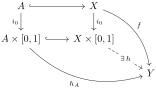
A pair \((X,A)\) of topological spaces has the homotopy extension property (HEP) if for every space \(Y\text{,}\) every continuous map \(f\colon X\to Y\text{,}\) and every homotopy \(h_A\colon A\times[0,1]\to Y\) with \(h_A(-,0)=f|_A\text{,}\) there exists a homotopy \(h\colon X\times[0,1]\to Y\) extending \(h_A\) with \(h(-,0)=f\text{.}\) In other words, the dashed arrow exists making the following diagram commute:
described in detail following the image
The homotopy extension property diagram: \(A\) includes into \(X\) across the top, and both map down via \(i_0\colon x\mapsto(x,0)\) into the products with \([0,1]\text{.}\) The map \(f\colon X\to Y\) and the partial homotopy \(h_A\colon A\times[0,1]\to Y\) are given, and the HEP asserts the existence of \(h\colon X\times[0,1]\to Y\text{.}\)
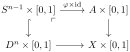
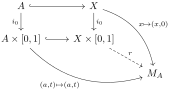
The HEP can be rephrased in terms of retracts. The pair \((X,A)\) has the HEP if and only if \(X\times\{0\}\cup A\times[0,1]\) is a retract of \(X\times[0,1]\text{.}\) For cell attachments, this retract can be constructed explicitly.
Proof.
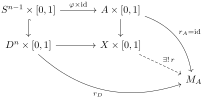
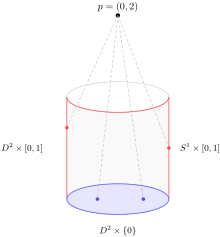
Project radially from the point \((0,2)\in D^n\times\mathbb{R}\) onto the subspace \(D^n\times\{0\}\cup S^{n-1}\times[0,1]\text{.}\) This defines a retraction \(r\colon D^n\times[0,1]\to D^n\times\{0\}\cup S^{n-1}\times[0,1]\text{.}\) The geometric picture: we project from a point "above" the cylinder onto its bottom face and lateral boundary. Here is an illustration in the case \(n=2\text{:}\)
described in detail following the image
The radial projection retraction for the pair \((D^2, S^1)\text{.}\) The cylinder \(D^2\times[0,1]\) is shown with its bottom face and lateral boundary highlighted. A point \(p=(0,2)\) above the cylinder projects radially onto \(D^2\times\{0\}\cup S^1\times[0,1]\text{,}\) defining the retraction.
Proof.
We construct the extension inductively over the skeletal filtration. It suffices to show that if \(X\) is obtained from \(A\) by attaching a single \(n\)-cell via \(\varphi\colon S^{n-1}\to A\text{,}\) then \((X,A)\) has the HEP β€” the general case follows by induction on skeleta and a colimit argument.
Given \(f\colon X\to Y\) and a homotopy \(h_A\colon A\times[0,1]\to Y\) with \(h_A(-,0)=f|_A\text{,}\) we need to extend to \(h\colon X\times[0,1]\to Y\text{.}\) The restriction of \(f\) to the cell \(D^n\) and the homotopy \(h_A\) on \(A\) together define a map on \(D^n\times\{0\}\cup S^{n-1}\times[0,1]\) (using \(h_A\circ(\varphi\times \mathrm{id})\) on \(S^{n-1}\times[0,1]\)). By LemmaΒ 2.10.31, this extends over \(D^n\times[0,1]\text{.}\) The extensions on \(A\times[0,1]\) and \(D^n\times[0,1]\) are compatible on \(S^{n-1}\times[0,1]\) by construction, so by the universal property of the pushout, they assemble into a homotopy \(h\colon X\times[0,1]\to Y\text{.}\)
The homotopy extension property has several powerful consequences, which we record as corollaries.
Proof.
Since \(A\) is contractible, there is a homotopy \(h_A\colon A\times[0,1]\to A\) from \(\mathrm{id}_A\) to a constant map. By the HEP, this extends to a homotopy \(h\colon X\times[0,1]\to X\) starting at \(\mathrm{id}_X\text{.}\) The map \(h(-,1)\) sends all of \(A\) to a single point, so it factors through \(X/A\text{,}\) and one checks this yields a homotopy inverse for \(q\text{.}\)
Proof.
Consider the space \(X\amalg_{\varphi_0}D^n\text{.}\) The homotopy between \(\varphi_0\) and \(\varphi_1\) can be used, via the HEP for the pair \((D^n, S^{n-1})\text{,}\) to construct a deformation of the attaching region. The mapping cylinder of the homotopy between attaching maps contains both spaces as deformation retracts.
Example 2.10.35. Collapsing a maximal tree in a graph.
Let \(\Gamma\) be a connected graph (a \(1\)-dimensional CW complex). A maximal tree \(T\subseteq\Gamma\) is a contractible subgraph containing all vertices. By CorollaryΒ 2.10.33, \(\Gamma/T\) is homotopy equivalent to \(\Gamma\text{.}\) Since \(T\) contains all vertices, the quotient \(\Gamma/T\) has a single vertex, and each edge not in \(T\) becomes a loop β€” so \(\Gamma/T\) is a wedge of circles. If \(\Gamma\) has \(V\) vertices, \(E\) edges, and \(T\) contains \(V-1\) edges (as any tree on \(V\) vertices must), then
\begin{equation*} \Gamma\simeq\Gamma/T\cong\bigvee_{E-V+1}S^1. \end{equation*}
In particular, \(\Gamma\simeq\bigvee_k S^1\) where \(k=1-\chi(\Gamma)\text{.}\)

Subsubsection Cellular maps

Definition 2.10.36. Cellular map.
A continuous map \(f\colon X\to Y\) between CW complexes is cellular if \(f(X^n)\subseteq Y^n\) for all \(n\ge 0\text{,}\) i.e., \(f\) preserves the skeletal filtrations.
Not every continuous map between CW complexes is cellular, but the following remarkable theorem β€” whose proof we will not give here β€” asserts that every map is homotopic to a cellular one.
The cellular approximation theorem is analogous to the simplicial approximation theorem in combinatorial topology. It implies that for the purposes of homotopy theory, it costs nothing to assume our maps are cellular. We will make essential use of this when studying homology.
Proof.
Give \(S^j\) its standard CW structure. By the cellular approximation theorem, any continuous map \(f\colon S^j\to X\) is homotopic to a cellular map \(g\colon S^j\to X\text{.}\) Since \(g\) is cellular, \(g(S^j)\subseteq X^j\text{.}\) But \(X^j=X^0\) is discrete and \(S^j\) is connected (for \(j\ge 1\)), so \(g\) is constant.

Subsubsection Suspensions and cones

Two constructions that arise frequently in algebraic topology β€” and that we will need for homology computations β€” are the cone and suspension.
Definition 2.10.39. Cone and (unreduced) suspension.
Let \(X\) be a topological space.
  1. The cone on \(X\) is the quotient
    \begin{equation*} CX := X\times[0,1]\big/(X\times\{1\}). \end{equation*}
    It is the space obtained by collapsing one end of the cylinder \(X\times[0,1]\) to a point (the cone point). The cone is always contractible.
  2. The (unreduced) suspension of \(X\) is the quotient
    \begin{equation*} \widetilde\Sigma X := X\times[0,1]\big/(X\times\{0\}\cup X\times\{1\}) \;=\; CX\big/(X\times\{0\}), \end{equation*}
    obtained by collapsing both ends of the cylinder to points (the north and south poles).
Remark 2.10.40. Reduced vs. unreduced suspension.
If \((X,x_0)\) is a pointed space (a space equipped with a chosen basepoint), the reduced suspension is the quotient
\begin{equation*} \Sigma X := \widetilde\Sigma X\big/(\{x_0\}\times[0,1]), \end{equation*}
which further collapses the "longitude" through the basepoint to a point. Equivalently, \(\Sigma X = X\wedge S^1\text{,}\) the smash product of \(X\) with the circle (where \(X\wedge Y := X\times Y/(X\vee Y)\) is the quotient of the product by the wedge). The reduced suspension is the standard suspension in the context of stable homotopy theory and generalized cohomology.
For CW complexes with basepoint a \(0\)-cell, the inclusion \(\{x_0\}\times[0,1]\hookrightarrow\widetilde\Sigma X\) makes \(\{x_0\}\times[0,1]\) a contractible subcomplex, so by CorollaryΒ 2.10.33 the quotient map \(\widetilde\Sigma X\to\Sigma X\) is a homotopy equivalence. In this course, we will primarily use the unreduced suspension \(\widetilde\Sigma X\text{,}\) since we are not yet systematically working in the pointed category.
Example 2.10.41.
The suspension of \(S^n\) is homeomorphic to \(S^{n+1}\text{:}\)
\begin{equation*} \widetilde\Sigma S^n\cong S^{n+1}. \end{equation*}
In particular, \(S^n\cong\widetilde\Sigma(S^{n-1})\cong\widetilde\Sigma^2(S^{n-2})\cong\cdots \cong\widetilde\Sigma^n(S^0)\text{,}\) where \(\widetilde\Sigma^k\) denotes the \(k\)-fold iterated suspension. Since \(S^0=\{-1,+1\}\text{,}\) this gives us an inductive construction of all spheres: each \(S^n\) is the suspension of the previous one.
If \(X\) is a CW complex, then both \(CX\) and \(\widetilde\Sigma X\) inherit CW structures. For \(\widetilde\Sigma X\text{:}\) there are two new \(0\)-cells (the poles), and for each \(n\)-cell \(e^n_\alpha\) of \(X\text{,}\) the suspension contributes an \((n+1)\)-cell \(e^{n+1}_\alpha\) to \(\widetilde\Sigma X\text{.}\) This observation will be essential when we compute the homology of spheres using the Mayer-Vietoris sequence.

Subsubsection Looking ahead: from spaces to algebra

We now have the geometric machinery β€” CW complexes, homotopy equivalence, and the homotopy extension property β€” to begin constructing algebraic invariants. Next week, we will define singular homology: for each space \(X\) and each integer \(n\ge 0\text{,}\) a group \(H_n(X)\) that captures \(n\)-dimensional "holes" in \(X\text{.}\) The key features of homology will be:
  1. Homotopy invariance. If \(X\simeq Y\text{,}\) then \(H_n(X)\cong H_n(Y)\) for all \(n\text{.}\)
  2. Dimension. \(H_n(\mathrm{pt})=0\) for \(n\ge 1\text{,}\) and \(H_0(\mathrm{pt})\cong\mathbb{Z}\text{.}\)
  3. Mayer-Vietoris. For \(X=A\cup B\text{,}\) there is a long exact sequence relating \(H_*(A\cap B)\text{,}\) \(H_*(A)\oplus H_*(B)\text{,}\) and \(H_*(X)\text{.}\)
Together with the CW structures we have built, these properties will let us compute \(H_*(S^n)\text{,}\) prove the Brouwer fixed-point theorem (stated without proof back in Week 2), and much more.