Section 2.12 Week 12

Subsection Monday

Last week we built singular homology, established its functoriality, and introduced the relative homology groups \(H_n(X,A)\) together with the long exact sequence of a pair. We closed by defining chain homotopies and showing that chain homotopic chain maps induce the same map on homology. This week we cash that in: we prove homotopy invariance of singular homology (Monday), develop the technology of barycentric subdivision needed to pass between large and small chains (Wednesday), and combine these to prove the excision theorem and the Mayer–Vietoris sequence (Friday). Mayer–Vietoris will let us at last compute \(H_*(S^n)\text{;}\) the remaining computations, including \(H_*(\mathbb{RP}^n)\text{,}\) will occupy week 13.

Subsubsection The prism operator

Our task is to construct, for any homotopy \(h\colon X\times[0,1]\to Y\) between continuous maps \(f,g\colon X\to Y\text{,}\) a chain homotopy \(P\) from \(f_\sharp\) to \(g_\sharp\text{.}\) The geometric idea is straightforward: a singular simplex \(\sigma\colon\Delta^n\to X\) together with the homotopy gives a "prism"
\begin{equation*} h\circ(\sigma\times\mathrm{id})\colon\Delta^n\times[0,1]\longrightarrow Y, \end{equation*}
and the boundary of this prism consists of the bottom \(f\circ\sigma\text{,}\) the top \(g\circ\sigma\text{,}\) and the side faces, which involve \(\partial\sigma\text{.}\) To turn this into an algebraic chain homotopy we need a canonical decomposition of the prism \(\Delta^n\times[0,1]\) into \((n+1)\)-simplices.
Definition 2.12.1. Simplicial decomposition of the prism.
Let \(\Delta^n=[v_0,\ldots,v_n]\) with \(v_i=e_i\text{.}\) Write the vertices of \(\Delta^n\times[0,1]\) as
\begin{equation*} v_i^- := (v_i,0), \qquad v_i^+ := (v_i,1), \qquad 0\le i\le n. \end{equation*}
For each \(0\le i\le n\text{,}\) let
\begin{equation*} \tau_i := \bigl[v_0^-,\ldots,v_i^-,v_i^+,\ldots,v_n^+\bigr] \end{equation*}
denote the affine-linear singular \((n+1)\)-simplex \(\tau_i\colon\Delta^{n+1}\to\Delta^n\times[0,1]\) sending the vertices of \(\Delta^{n+1}\) in order to \(v_0^-,\ldots,v_i^-,v_i^+,\ldots,v_n^+\text{.}\) The simplices \(\tau_0,\ldots,\tau_n\) have pairwise disjoint interiors and their images cover \(\Delta^n\times[0,1]\text{.}\)
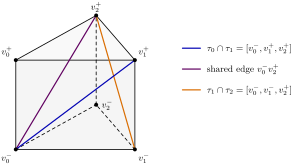
For \(n=2\text{,}\) the prism \(\Delta^2\times[0,1]\) is a triangular prism, and the decomposition produces three tetrahedra \(\tau_0=[v_0^-,v_0^+,v_1^+,v_2^+]\text{,}\) \(\tau_1=[v_0^-,v_1^-,v_1^+,v_2^+]\text{,}\) and \(\tau_2=[v_0^-,v_1^-,v_2^-,v_2^+]\text{.}\) They are separated by two interior triangular cuts \([v_0^-,v_1^+,v_2^+]\) (between \(\tau_0\) and \(\tau_1\)) and \([v_0^-,v_1^-,v_2^+]\) (between \(\tau_1\) and \(\tau_2\)); these cuts add three new (interior) edges, drawn in color below.
described in detail following the image
The triangular prism \(\Delta^2\times[0,1]\) with vertices \(v_0^-,v_1^-,v_2^-\) on the bottom face and \(v_0^+,v_1^+,v_2^+\) on the top face, decomposed into three tetrahedra \(\tau_0,\tau_1,\tau_2\) by the three interior diagonal edges \(v_0^-v_1^+\text{,}\) \(v_0^-v_2^+\text{,}\) and \(v_1^-v_2^+\text{.}\)
Definition 2.12.2. Prism operator.
Let \(h\colon X\times[0,1]\to Y\) be a homotopy. The prism operator \(P_n\colon C_n(X)\to C_{n+1}(Y)\) is defined on a generator \(\sigma\colon\Delta^n\to X\) by
\begin{equation*} P_n(\sigma) := \sum_{i=0}^n (-1)^i\,(h\circ(\sigma\times\mathrm{id}))\circ\tau_i, \end{equation*}
and extended linearly to all of \(C_n(X)\text{.}\)
Each summand \((h\circ(\sigma\times\mathrm{id}))\circ\tau_i\) is a singular \((n+1)\)-simplex in \(Y\text{;}\) intuitively it is the image in \(Y\) of the \(i\)-th piece of the prism. The signs are chosen so that the algebraic boundary of \(P_n(\sigma)\) reproduces the geometric boundary of the prism.

Subsubsection Homotopy invariance

Proof.
By linearity it suffices to evaluate both sides on a generator \(\sigma\colon\Delta^n\to X\text{.}\) Let \(H:=h\circ(\sigma\times\mathrm{id})\colon\Delta^n\times[0,1]\to Y\text{.}\) We compute \(\partial_{n+1}P_n(\sigma)\) using the definition of the boundary on each \(\tau_i\text{.}\) The face of \(\tau_i\) obtained by omitting the vertex with label \(j\) falls into one of three classes:
(a) The faces internal to the prism (omitting \(v_i^-\) from \(\tau_i\) yields the same face as omitting \(v_i^+\) from \(\tau_{i-1}\text{,}\) with opposite sign). All such internal faces cancel pairwise.
(b) The top face (omitting all "minus" vertices from \(\tau_n\text{,}\) i.e., \(j=0\) in \(\tau_n\)) gives \(g\circ\sigma\text{.}\)
(c) The bottom face (omitting all "plus" vertices from \(\tau_0\text{,}\) i.e., \(j=n+1\) in \(\tau_0\)) gives \(-(-1)^0 f\circ\sigma\cdot(-1)^{n+1}\cdot(-1)^{n+1} = -f\circ\sigma\text{;}\) tracking the alternating signs carefully yields exactly \(-f_\sharp\sigma\text{.}\)
(d) The side faces (omitting \(v_j^-\) with \(j<i\text{,}\) or \(v_j^+\) with \(j>i\)) reassemble to \(-P_{n-1}(\partial_n\sigma)\text{.}\) Indeed, the faces involving \(\sigma\circ d_j\) are precisely the prism over the \(j\)-th face of \(\sigma\text{,}\) with the correct signs.
Combining (a)–(d) gives \(\partial_{n+1}P_n(\sigma) = g_\sharp\sigma - f_\sharp\sigma - P_{n-1}(\partial_n\sigma)\text{,}\) which is the desired identity. The detailed sign verification, while tedious, reduces to the simplicial identities for the face maps \(d_i\text{;}\) see Hatcher, Theorem 2.10 for a fully explicit accounting.
Proof.
Choose a homotopy \(h\) from \(f\) to \(g\text{.}\) By Lemma 2.12.3, the prism operator \(P\) is a chain homotopy from \(f_\sharp\) to \(g_\sharp\text{.}\) By Lemma 2.11.23, chain homotopic chain maps induce equal maps on homology, so \(f_*=g_*\text{.}\)
Proof.
Let \(g\colon Y\to X\) be a homotopy inverse, so that \(g\circ f\simeq\mathrm{id}_X\) and \(f\circ g\simeq\mathrm{id}_Y\text{.}\) By functoriality (Proposition 2.11.14) and homotopy invariance,
\begin{equation*} g_*\circ f_* = (g\circ f)_* = (\mathrm{id}_X)_* = \mathrm{id}_{H_n(X)}, \end{equation*}
and similarly \(f_*\circ g_*=\mathrm{id}_{H_n(Y)}\text{.}\) So \(f_*\) is an isomorphism with inverse \(g_*\text{.}\)
The corollary makes our earlier corollary Corollary 2.11.21 precise: if \(X\) is contractible, then the unique map \(X\to\mathrm{pt}\) is a homotopy equivalence, so \(\widetilde{H}_n(X)\cong\widetilde{H}_n(\mathrm{pt})=0\) for all \(n\text{.}\) Concretely, \(\widetilde{H}_n(\mathbb{R}^k)=0\text{,}\) \(\widetilde{H}_n(D^k)=0\text{,}\) and \(\widetilde{H}_n(\mathrm{cone}(Y))=0\) for every space \(Y\) and every \(k,n\text{.}\)

Subsubsection Relative homotopy invariance

The same prism construction gives homotopy invariance of relative homology, provided we track the subspaces. A map of pairs \(f\colon(X,A)\to(Y,B)\) is a continuous map \(f\colon X\to Y\) with \(f(A)\subseteq B\text{.}\) Two such maps \(f,g\) are homotopic as maps of pairs if there is a homotopy \(h\colon X\times[0,1]\to Y\) from \(f\) to \(g\) with \(h(A\times[0,1])\subseteq B\text{.}\)
Proof.
The prism operator built from \(h\) sends \(C_n(A)\) into \(C_{n+1}(B)\) because \(h(A\times[0,1])\subseteq B\text{.}\) Hence it descends to a chain homotopy on the relative chain complexes \(C_\bullet(X,A)\to C_\bullet(Y,B)\text{,}\) and Lemma 2.11.23 applies as before.
Calling a map of pairs \(f\colon(X,A)\to(Y,B)\) a homotopy equivalence of pairs if it admits a homotopy inverse of pairs, we obtain \(H_n(X,A)\cong H_n(Y,B)\) whenever \((X,A)\) and \((Y,B)\) are homotopy equivalent pairs. We will use this freely on Friday.

Subsection Wednesday

The remaining major hurdle on the way to Mayer–Vietoris is to compare the homology computed from all singular simplices to the homology computed from singular simplices that are "small" with respect to a chosen open cover. The bridge is barycentric subdivision, a chain map \(S\colon C_n(X)\to C_n(X)\) together with a chain homotopy from \(S\) to the identity. Iterating \(S\) shrinks any simplex eventually inside any prescribed open cover.

Subsubsection Barycenters and the cone construction

Definition 2.12.7. Barycenter.
The barycenter of an affine simplex \([w_0,\ldots,w_n]\) in a convex set is the point
\begin{equation*} b[w_0,\ldots,w_n] := \frac{1}{n+1}\sum_{i=0}^n w_i. \end{equation*}
For the standard simplex \(\Delta^n=[v_0,\ldots,v_n]\) we write \(b_n:=b[v_0,\ldots,v_n]\text{.}\)
Let \(Y\subseteq\mathbb{R}^N\) be a convex set, and let \(LC_n(Y)\subseteq C_n(Y)\) denote the subgroup generated by \(affine\) singular simplices, i.e., affine-linear maps \(\Delta^n\to Y\text{.}\) We write an affine simplex by its vertices: \([w_0,\ldots,w_n]\text{.}\) The boundary operator restricts to \(LC_\bullet(Y)\) by \(\partial[w_0,\ldots,w_n]=\sum_i(-1)^i[w_0,\ldots,\widehat{w_i},\ldots,w_n]\text{.}\)
Definition 2.12.8. Cone operator.
For a point \(b\in Y\text{,}\) the cone operator \(b\colon LC_n(Y)\to LC_{n+1}(Y)\) is defined on generators by
\begin{equation*} b\cdot[w_0,\ldots,w_n] := [b,w_0,\ldots,w_n]. \end{equation*}
Proof.
Both formulas are immediate from the definition: omitting the vertex \(b\) from \([b,w_0,\ldots,w_n]\) gives \(\alpha\text{,}\) and omitting any other vertex \(w_i\) gives \(b\cdot\) (the corresponding face of \(\alpha\)).
The cone relation expresses the geometric fact that a cone \(b\cdot\alpha\) is a nullhomotopy of \(\alpha\text{:}\) its boundary is \(\alpha\) minus a chain involving the apex \(b\text{.}\) We will use this repeatedly to construct chain homotopies.

Subsubsection Barycentric subdivision

Definition 2.12.10. Subdivision of affine simplices.
Define \(S\colon LC_n(Y)\to LC_n(Y)\) recursively on generators. For \(n=0\text{,}\) set \(S[w_0]:=[w_0]\text{.}\) For \(n\ge 1\text{,}\) let \(\beta:=[w_0,\ldots,w_n]\) with barycenter \(b_\beta\text{,}\) and define
\begin{equation*} S(\beta) := b_\beta\cdot S(\partial\beta). \end{equation*}
That is, subdivide the boundary, then cone from the barycenter.
Unrolling the recursion shows that \(S(\beta)\) is a signed sum of all \((n+1)!\) simplices \([b_{F_0},b_{F_1},\ldots,b_{F_n}]\text{,}\) where \(F_0\subsetneq F_1\subsetneq\cdots\subsetneq F_n=\beta\) is a chain of faces, and \(b_F\) denotes the barycenter of \(F\text{.}\) Geometrically, \(S(\beta)\) is the familiar barycentric subdivision of the simplex \(\beta\text{.}\)
Proof.
By induction on \(n\text{.}\) The base case \(n=0\) is immediate. For \(n\ge 1\text{,}\) using Lemma 2.12.9 and the inductive hypothesis,
\begin{equation*} \partial S(\beta) = \partial(b_\beta\cdot S(\partial\beta)) = S(\partial\beta) - b_\beta\cdot\partial S(\partial\beta) = S(\partial\beta) - b_\beta\cdot S(\partial^2\beta) = S(\partial\beta), \end{equation*}
since \(\partial^2=0\text{.}\)
We now extend \(S\) to general singular chains. Given a singular simplex \(\sigma\colon\Delta^n\to X\text{,}\) define
\begin{equation*} S(\sigma) := \sigma_\sharp\bigl(S(\iota_n)\bigr), \end{equation*}
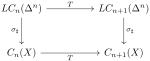
where \(\iota_n\colon\Delta^n\to\Delta^n\) is the identity (regarded as an affine singular simplex in the convex set \(\Delta^n\)) and \(\sigma_\sharp\colon C_\bullet(\Delta^n)\to C_\bullet(X)\) is the chain map induced by \(\sigma\text{.}\) Naturality is built in: \(S\) is now a natural transformation \(C_\bullet\Rightarrow C_\bullet\) on the category of topological spaces. The chain map property \(\partial S=S\partial\) on general singular chains follows from the affine case applied to \(\iota_n\text{.}\)
Proof.
On affine chains in a convex set \(Y\text{,}\) define \(T\) recursively by \(T[w_0]:=0\) and, for \(n\ge 1\text{,}\)
\begin{equation*} T(\beta) := b_\beta\cdot\bigl(S(\beta)-\beta-T(\partial\beta)\bigr). \end{equation*}
By induction (using Lemma 2.12.9 and Lemma 2.12.11),
\begin{equation*} \partial T(\beta) = S(\beta)-\beta-T(\partial\beta) - b_\beta\cdot\partial(S(\beta)-\beta-T(\partial\beta)). \end{equation*}
The bracketed inner expression equals \(S(\partial\beta)-\partial\beta-(S(\partial\beta)-\partial\beta-T(\partial^2\beta))=0\) by induction (the case \(n=1\) uses the augmentation form of the cone relation and verifies directly). So \(\partial T(\beta)+T(\partial\beta)=S(\beta)-\beta\text{.}\) Extending to general singular chains by \(T(\sigma):=\sigma_\sharp T(\iota_n)\) and using naturality gives the result on \(C_\bullet(X)\text{.}\)

Subsubsection Iterated subdivision and the small chains theorem

Let \(\mathcal{U}=\{U_\alpha\}\) be a collection of subspaces of \(X\) whose interiors cover \(X\text{.}\) We say a singular simplex \(\sigma\colon\Delta^n\to X\) is \(\mathcal{U}\)-small if \(\sigma(\Delta^n)\subseteq U_\alpha\) for some \(\alpha\text{.}\) Let
\begin{equation*} C_n^{\mathcal{U}}(X)\subseteq C_n(X) \end{equation*}
denote the subgroup generated by \(\mathcal{U}\)-small singular simplices. Since the boundary of a \(\mathcal{U}\)-small simplex is again a sum of \(\mathcal{U}\)-small simplices, \(C_\bullet^{\mathcal{U}}(X)\) is a subcomplex. Write \(H_n^{\mathcal{U}}(X)\) for its homology and \(\iota\colon C_\bullet^{\mathcal{U}}(X)\hookrightarrow C_\bullet(X)\) for the inclusion.
Proof.
Given \(\sigma\colon\Delta^n\to X\text{,}\) the open cover \(\{\sigma^{-1}(\mathrm{int}\,U_\alpha)\}\) of the compact metric space \(\Delta^n\) has a Lebesgue number \(\delta_\sigma>0\text{.}\) The diameter of an affine simplex strictly decreases under barycentric subdivision: if \(\Delta\) has diameter \(d\text{,}\) then every simplex of \(S(\Delta)\) has diameter at most \(\frac{n}{n+1}d\text{.}\) Hence after sufficiently many subdivisions \(S^{m_\sigma}(\sigma)\text{,}\) every simplex appearing has diameter less than \(\delta_\sigma\text{,}\) so its image lies inside some \(U_\alpha\text{.}\)
Define a homomorphism \(D_n\colon C_n(X)\to C_{n+1}(X)\) as the "telescoping chain homotopy" associated with iteration of the chain homotopy \(T\) from Lemma 2.12.12:
\begin{equation*} D_n(\sigma) := \sum_{i=0}^{m_\sigma-1} T S^i(\sigma). \end{equation*}
One verifies \(\partial D + D\partial = S^{m_\sigma}-\mathrm{id}\) on each generator \(\sigma\text{,}\) and the residue \(S^{m_\sigma}(\sigma)\) lies in \(C_n^{\mathcal{U}}(X)\text{.}\) Defining \(\rho(\sigma):=S^{m_\sigma}(\sigma) - \partial D(\sigma) - D(\partial\sigma)\) after a small adjustment (to ensure \(\rho\) takes values in \(C_\bullet^{\mathcal{U}}(X)\)) produces a chain map \(\rho\colon C_\bullet(X)\to C_\bullet^{\mathcal{U}}(X)\) with \(\iota\rho\simeq\mathrm{id}\) and \(\rho\iota=\mathrm{id}\text{.}\) The full verification appears in Hatcher, Proposition 2.21.
The takeaway is precisely what we want: for any open cover \(\mathcal{U}\) of \(X\text{,}\) every homology class is represented by a chain whose simplices are entirely contained in members of \(\mathcal{U}\text{,}\) and two such chains are homologous via small chains whenever they are homologous at all.

Subsection Friday

Today we reach the destination of the last three weeks: the excision theorem, the Mayer–Vietoris sequence, and our first major computation — \(H_*(S^n)\text{.}\) As an immediate payoff we deduce the Brouwer fixed point theorem and see that \(\mathbb{R}^m\) and \(\mathbb{R}^n\) are not homeomorphic when \(m\neq n\text{.}\)

Subsubsection Excision

Proof.
Let \(B:=X\setminus Z\text{.}\) The hypothesis \(\overline{Z}\subseteq\mathrm{int}\,A\) implies \(\mathrm{int}\,A\cup\mathrm{int}\,B = X\text{,}\) so \(\mathcal{U}:=\{A,B\}\) is a cover whose interiors cover \(X\text{.}\) Let \(C_\bullet^{\mathcal{U}}(X)\) be the subcomplex of \(\mathcal{U}\)-small chains and \(C_\bullet^{\mathcal{U}}(X,A):=C_\bullet^{\mathcal{U}}(X)/C_\bullet(A)\) the corresponding relative complex. By Theorem 2.12.13 and the five lemma applied to the long exact sequence of the pair, the inclusion \(C_\bullet^{\mathcal{U}}(X,A)\hookrightarrow C_\bullet(X,A)\) induces an isomorphism on homology.
On the other hand, every \(\mathcal{U}\)-small chain decomposes uniquely (modulo chains in \(A\)) as a sum of a chain in \(A\) and a chain in \(B\text{.}\) The inclusion \(C_\bullet(B)\hookrightarrow C_\bullet^{\mathcal{U}}(X)\) therefore descends to an isomorphism of relative complexes
\begin{equation*} C_\bullet(B)/C_\bullet(A\cap B)\;\xrightarrow{\;\sim\;}\;C_\bullet^{\mathcal{U}}(X)/C_\bullet(A). \end{equation*}
Since \(B=X\setminus Z\) and \(A\cap B=A\setminus Z\text{,}\) the left side is \(C_\bullet(X\setminus Z, A\setminus Z)\text{.}\) Composing the two isomorphisms yields the result.
Excision is the fundamental "locality" property of singular homology: removing a well-embedded subspace from both \(X\) and \(A\) does not change the relative homology. It is what distinguishes homology from, say, the homotopy groups \(\pi_n\text{,}\) which are not excisive.

Subsubsection The Mayer–Vietoris sequence

Let \(X=A\cup B\) with \(A,B\) subspaces whose interiors cover \(X\text{.}\) The small chains theorem provides a short exact sequence
\begin{equation*} 0\to C_n(A\cap B)\xrightarrow{\;(i,-j)\;} C_n(A)\oplus C_n(B)\xrightarrow{\;k+\ell\;} C_n^{\mathcal{U}}(X)\to 0, \end{equation*}
where \(i\colon A\cap B\hookrightarrow A\text{,}\) \(j\colon A\cap B\hookrightarrow B\text{,}\) \(k\colon A\hookrightarrow X\text{,}\) and \(\ell\colon B\hookrightarrow X\) are the inclusions. (Exactness at the middle term is the "decomposition" used in the proof of excision; surjectivity at the right is the small chains theorem.) Passing to homology via the snake lemma yields:
Proof.
Apply the long exact sequence in homology to the short exact sequence of chain complexes displayed above, and use the small chains isomorphism \(H_n^{\mathcal{U}}(X)\cong H_n(X)\text{.}\)
There is also a reduced version: if \(A\cap B\) is nonempty, the same argument applied to the augmented complexes gives an exact sequence
\begin{equation*} \cdots\to\widetilde{H}_n(A\cap B)\to\widetilde{H}_n(A)\oplus\widetilde{H}_n(B)\to\widetilde{H}_n(X)\to\widetilde{H}_{n-1}(A\cap B)\to\cdots \end{equation*}
We will use the reduced form for spheres.
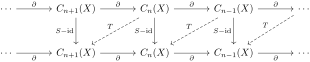
Schematically, the Mayer–Vietoris sequence reads:
The Mayer–Vietoris long exact sequence rendered as a zigzag, with rows for each degree connected by the connecting homomorphism.

Subsubsection Homology of spheres

Proof.
The case \(n=0\) is direct: \(S^0\) is two points, so \(H_0(S^0)\cong\mathbb{Z}^2\) and \(H_k(S^0)=0\) for \(k\ge 1\) by Proposition 2.11.11 and Proposition 2.11.20. We proceed by induction on \(n\ge 1\text{.}\)
Cover \(S^n\) by \(A:=S^n\setminus\{N\}\) and \(B:=S^n\setminus\{S\}\text{,}\) the complements of the north and south poles. Both \(A\) and \(B\) are open, and stereographic projection gives homeomorphisms \(A\cong\mathbb{R}^n\cong B\text{.}\) In particular \(A\) and \(B\) are contractible, so \(\widetilde{H}_*(A)=\widetilde{H}_*(B)=0\) by Corollary 2.11.21. The intersection \(A\cap B\) deformation retracts onto the equatorial \(S^{n-1}\text{;}\) concretely, the radial projection \((x,t)\mapsto x/|x|\) realizes \(A\cap B\simeq S^{n-1}\text{.}\)
The reduced Mayer–Vietoris sequence becomes
\begin{equation*} \cdots\to\widetilde{H}_k(A)\oplus\widetilde{H}_k(B)\to\widetilde{H}_k(S^n)\xrightarrow{\partial_*}\widetilde{H}_{k-1}(S^{n-1})\to\widetilde{H}_{k-1}(A)\oplus\widetilde{H}_{k-1}(B)\to\cdots \end{equation*}
which, since the \(A\)- and \(B\)-terms vanish, collapses to isomorphisms
\begin{equation*} \partial_*\colon\widetilde{H}_k(S^n)\xrightarrow{\;\sim\;}\widetilde{H}_{k-1}(S^{n-1})\quad\text{for all } k\ge 1. \end{equation*}
By induction \(\widetilde{H}_{k-1}(S^{n-1})\) is \(\mathbb{Z}\) when \(k-1=n-1\) and zero otherwise, giving the claim. The case \(k=0\) is handled by path-connectedness of \(S^n\) for \(n\ge 1\text{.}\)

Subsubsection Applications

Two classical consequences are immediate.
Proof.
Suppose \(m,n\ge 1\text{.}\) If \(S^m\simeq S^n\text{,}\) then \(\widetilde{H}_*(S^m)\cong\widetilde{H}_*(S^n)\) by Corollary 2.12.5; but Theorem 2.12.16 shows these are concentrated in different degrees. For \(\mathbb{R}^m\not\cong\mathbb{R}^n\text{,}\) observe that a hypothetical homeomorphism would restrict to a homeomorphism \(\mathbb{R}^m\setminus\{0\}\cong\mathbb{R}^n\setminus\{0'\}\) for some point \(0'\text{.}\) Since \(\mathbb{R}^k\setminus\{0\}\simeq S^{k-1}\text{,}\) this would give \(S^{m-1}\simeq S^{n-1}\text{,}\) contradicting the previous statement. The remaining cases (\(m=0\) or \(n=0\)) are handled by counting connected components.
Proof.
Such a retraction would give, with \(\iota\colon S^{n-1}\hookrightarrow D^n\text{,}\) \(r\circ\iota=\mathrm{id}_{S^{n-1}}\text{,}\) whence \(r_*\circ\iota_*=\mathrm{id}\) on \(\widetilde{H}_{n-1}\text{.}\) But \(\widetilde{H}_{n-1}(D^n)=0\) while \(\widetilde{H}_{n-1}(S^{n-1})\cong\mathbb{Z}\) — contradiction.
Proof.
Suppose \(f(x)\neq x\) for all \(x\in D^n\text{.}\) Define \(r\colon D^n\to S^{n-1}\) by sending \(x\) to the point where the ray from \(f(x)\) through \(x\) meets \(S^{n-1}\text{.}\) Then \(r\) is continuous and \(r|_{S^{n-1}}=\mathrm{id}\) (a point on the boundary maps to itself), giving a retraction \(D^n\to S^{n-1}\text{.}\) This contradicts Corollary 2.12.18.
Next week we will leverage Mayer–Vietoris (and a related "good pair" version of excision) to compute the homology of further spaces, including the real projective spaces \(\mathbb{RP}^n\text{.}\) The key new input there is to understand the effect on homology of attaching a single cell — in effect, a Mayer–Vietoris computation for the pair \((\mathbb{RP}^n,\mathbb{RP}^{n-1})\) — which leads naturally into cellular homology and the calculation
\begin{equation*} H_k(\mathbb{RP}^n) \cong \begin{cases} \mathbb{Z} \amp k=0,\\ \mathbb{Z}/2 \amp 0<k<n,\;k\text{ odd},\\ 0 \amp 0<k<n,\;k\text{ even},\\ \mathbb{Z} \amp k=n,\;n\text{ odd},\\ 0 \amp k=n,\;n\text{ even},\\ 0 \amp k>n. \end{cases} \end{equation*}